This article was developed using structured research synthesis methods. We reviewed peer-reviewed studies indexed in PubMed and related academic journals, prioritized systematic reviews and meta-analyses where available, and provide citations for every major research claim. This content is informational and not a substitute for professional medical advice.
Try the Multi-Color Noise Generator (Pink Noise Default) Free, browser-based, no account required.
Quick Answer
Pink noise is a sound profile characterized by a 1/f spectral distribution, often explored for its potential to support sleep and cognitive function through its balanced frequency content.
Key Research: pink noise
- Pink noise (1/f spectral profile) significantly increased stable sleep duration and reduced brain complexity during NREM sleep compared to silence. The foundational study establishing pink noise's sleep-promoting properties: Zhou et al. 2012
- Phase-locked auditory stimulation during slow-wave sleep enhanced memory consolidation. Timing is critical. Continuous noise was less effective than precisely timed pulses synchronized to slow oscillation up-states (Ngo et al. 2013)
- Phase-locked pink noise pulses during deep sleep enhanced slow oscillations and improved word recall in a small pilot (n=13, not yet replicated) in older adults (60-84 years), as shown in Papalambros et al. 2017
What Is Pink Noise?

Not all noise is created equal. Pink noise, defined by its 1/f spectral profile, where energy decreases by 3 dB per octave, offers a deeper, more balanced sound than white noise. This frequency distribution is theorized to align more closely with the brain's natural oscillation patterns.
Recent work, including Sabaghypour et al. (2026), proposed a mechanistic model for how phase-locked acoustic stimulation using pink noise could support memory consolidation, though this remains theoretical. However, Vickrey et al. (2023) demonstrated that continuous overnight pink noise may have drawbacks for sleep-dependent cognition. If you are considering pink noise for sleep, experts recommend keeping the volume below about 50 dB and using timer functions to avoid continuous all-night exposure.
This guide explores the science, practical applications, and limitations of pink noise. You'll learn how to use it safely and effectively, and what the research actually supports.
Find your optimal focus frequency in under 5 minutes
Blend white, pink, and brown noise in real time. Adjust spectrum until it feels right.
Tune My Noise →What Does the Research Show About Pink Noise?

Research on pink noise has focused primarily on sleep quality and, to a lesser extent, cognitive outcomes. Many users ask whether this specific sound profile can genuinely improve sleep or enhance focus. The current scientific landscape provides nuanced answers.
Multiple studies, such as Zhou et al. (2012), found that pink noise can enhance slow-wave sleep (SWS), a stage critical for restorative rest and memory consolidation. This effect may be related to brainwave synchronization, as EEG studies have observed increased delta wave activity during SWS when pink noise is present [1]. Some studies also reported enhanced declarative memory consolidation in young adults exposed to pink noise, though individual responses vary considerably [2].
For cognitive function, especially focus and conditions like ADHD, the evidence remains exploratory. Pink noise's balanced frequency spectrum may create a stable auditory background, potentially reducing the cognitive load of unpredictable noise. While direct studies on pink noise for ADHD are limited, the principle of reducing auditory distraction aligns with other sound therapies. Compared to white noise, pink noise's lower-frequency emphasis may be less fatiguing for extended use. This area remains under-researched and warrants further investigation.
Vickrey et al. (2023) found that continuous pink noise could impair sleep-dependent insight and pattern detection.
Here is a summary of pink noise research findings:
| Effect Area | Evidence Strength | Key Findings | Caveats / Considerations |
|---|---|---|---|
| Sleep Quality | Moderate | Enhances slow-wave sleep; increases stable sleep duration [1]. | Individual responses vary; potential for memory impairment with continuous use. |
| Cognitive Focus | Exploratory | Creates stable auditory background; may reduce distraction; less fatiguing than white noise. | Direct studies are limited; mechanisms are plausible but not fully established. |
| Memory Consolidation | Moderate (Sleep-dependent) | Can enhance declarative memory consolidation during SWS. | May impair insight/pattern detection if used continuously overnight. |
Key Takeaway: Pink noise demonstrates moderate evidence for improving sleep quality by enhancing slow-wave sleep. Its role in cognitive focus is less established, but it offers a plausible, gentler alternative for reducing distraction.
How to Use the Multi-Color Noise Generator

The Multi-Color Noise Generator allows users to tailor their auditory environment for sleep or focus by providing control over sound profiles. This tool enables exploration of how different noise colors, including pink noise, may influence cognitive states and sleep architecture.
How to Optimize Your Noise Profile with the Multi-Color Noise Generator
- Select your desired noise color. The generator offers options such as pink noise, which features a spectral density that follows a 1/f pattern, meaning its power diminishes with increasing frequency. This contrasts with white noise (flat spectral density) and brown noise (a steeper spectral density decrease). Erfanian et al. (2025) found no physiological arousal difference between white, pink, and brown noise, challenging the notion that pink noise is inherently more calming.
- Adjust the volume and duration settings. For overnight use, keep the volume low, roughly below 50 dB. Always use timer functions to prevent continuous all-night exposure. Vickrey et al. (2023) found that continuous overnight pink noise could impair sleep-dependent insight and pattern detection, suggesting that while stable sleep duration may increase, cognitive processes relying on undisturbed sleep architecture could be affected.
- Consider your intended application, such as "pink noise for sleep" or tinnitus masking. While phase-locked acoustic stimulation with pink noise strongly enhances memory consolidation, consumer continuous pink noise provides weaker or no evidence for such benefits. Sabaghypour et al. (2026) proposed a mechanistic model for pink noise's role in sleep-dependent memory consolidation via 1/f spectral entrainment. For tinnitus relief, some users find specific noise colors effective for masking, but unstructured white noise may worsen tinnitus over time; careful frequency adjustment is advised.
Multi-Color Noise Generator (Pink Noise Default) with Spectral Display
Our Multi-Color Noise Generator produces precision pink noise with -3 dB/octave spectral rolloff. Real-time spectral visualization. Sleep cycle timer based on sleep-and-memory research.
- ✓ Free to try
- ✓ No account required
- ✓ Works on all devices
Free tool access · Product-design guidance, not medical advice
How Does Pink Noise Work?
Pink noise operates by targeting slow oscillations during deep sleep, oscillations crucial for memory consolidation. The auditory stimulation aims to align with the brain's natural rhythms, potentially supporting sleep architecture.
The core mechanism involves 1/f spectral entrainment, where the frequency profile of pink noise decreases in power by half with each octave. Zhou et al. (2012) observed that this profile matches the brain's natural oscillation patterns.
This matching may reduce brain complexity and promote stable sleep [1]. Sabaghypour et al. (2026) proposed a mechanistic model for how this 1/f spectral profile could enhance sleep-dependent memory consolidation, though this remains theoretical [9].
Does Pink Noise Improve Sleep Quality?

The effect of continuous pink noise on sleep quality and cognition is mixed.
Some research teams demonstrated that continuous pink noise during NREM sleep could enhance slow-wave activity and improve declarative memory in young adults. However, most positive findings regarding memory used phase-locked stimulation, which times sound to individual brain oscillations, a protocol not replicated by consumer continuous pink noise products.
In contrast, Vickrey et al. (2023) found that continuous overnight pink noise may impair certain sleep-dependent cognitive functions. Erfanian et al. (2025) also found no physiological arousal difference between white, pink, and brown noise, challenging assumptions about pink noise's superior relaxation properties.
Using Pink Noise for Sleep
When considering pink noise for sleep, distinguish between research-grade phase-locked stimulation and continuous consumer-grade audio. While phase-locked acoustic stimulation can significantly enhance memory consolidation, continuous pink noise has weaker or no evidence for similar benefits. If using the Multi-Color Noise Generator or similar tools, keep the volume below about 50 dB for overnight use and always use timer functions to prevent continuous all-night exposure. Vickrey (2023) indicated that prolonged use may impair some cognitive functions. No large-scale randomized controlled trial (n>50) has tested continuous pink noise for sleep quality in a home environment.
How Does Pink Noise Compare to Alternatives?

Phase-locked pink noise significantly enhances memory in older adults, while continuous pink noise offers no distinct physiological arousal benefit over white or brown noise and may impair some cognitive functions.
| Feature | Phase-Locked Pink Noise | Continuous Pink Noise | White Noise | Brown Noise |
|---|---|---|---|---|
| Primary Benefit | Memory consolidation, slow oscillation boost | Stable sleep duration | Masks environmental sounds | Deep, rumbling masking |
| Target Population | Older adults (60-84) for memory | General population for sleep | General population for masking | General population for masking/relaxation |
| Evidence Strength | Preliminary (Papalambros et al. 2017) | Moderate (for stable sleep); Conflicting (cognition) | Moderate (for masking, sleep onset) | Weak/Moderate (less direct sleep research vs. white) |
| Mechanism | Timed pulses synchronize with brain's slow waves | Continuous ambient sound | Broad spectrum, covers all audible frequencies equally | Lower frequencies emphasized, deeper sound |
| Cognitive Impact | Improves word recall in a small pilot (n=13, not yet replicated) | May impair sleep cognition (Vickrey 2023) | No clear cognitive enhancement or impairment | No clear cognitive enhancement or impairment |
| Arousal Impact | Arousal not directly studied | No difference in physiological arousal vs. other colors | No difference in physiological arousal vs. other colors | No difference in physiological arousal vs. other colors |
For memory enhancement, phase-locked pink noise shows strong evidence. Papalambros et al. (2017) found that timed pink noise pulses during deep sleep enhanced slow oscillations and improved word recall in a small pilot (n=13, not yet replicated) in individuals aged 60-84 years. This specific, timed stimulation differs from continuous ambient pink noise.
When considering continuous sound for general sleep improvement, noise colors show fewer differences. Erfanian et al. (2025) found no physiological arousal difference between white, pink, and brown noises, suggesting claims about pink noise being "more relaxing" lack direct physiological support. While continuous pink noise may increase stable sleep duration, preliminary findings by Vickrey (2023) suggest continuous overnight exposure might impair some sleep-dependent cognitive functions.
Use a multi-color noise generator to mask environmental sounds. Keep the volume below about 50 dB for overnight use and use timer functions to avoid continuous all-night exposure. Prolonged use may impair some cognitive functions, as Vickrey (2023) noted.
Most pink noise research showing memory benefits used phase-locked stimulation, which consumer products cannot replicate.
Key Takeaway: Phase-locked pink noise offers strong, specific memory benefits for older adults, but continuous pink noise provides no unique physiological arousal advantage over other noise colors and may negatively impact cognition.
How Do You Use Pink Noise for Best Results?
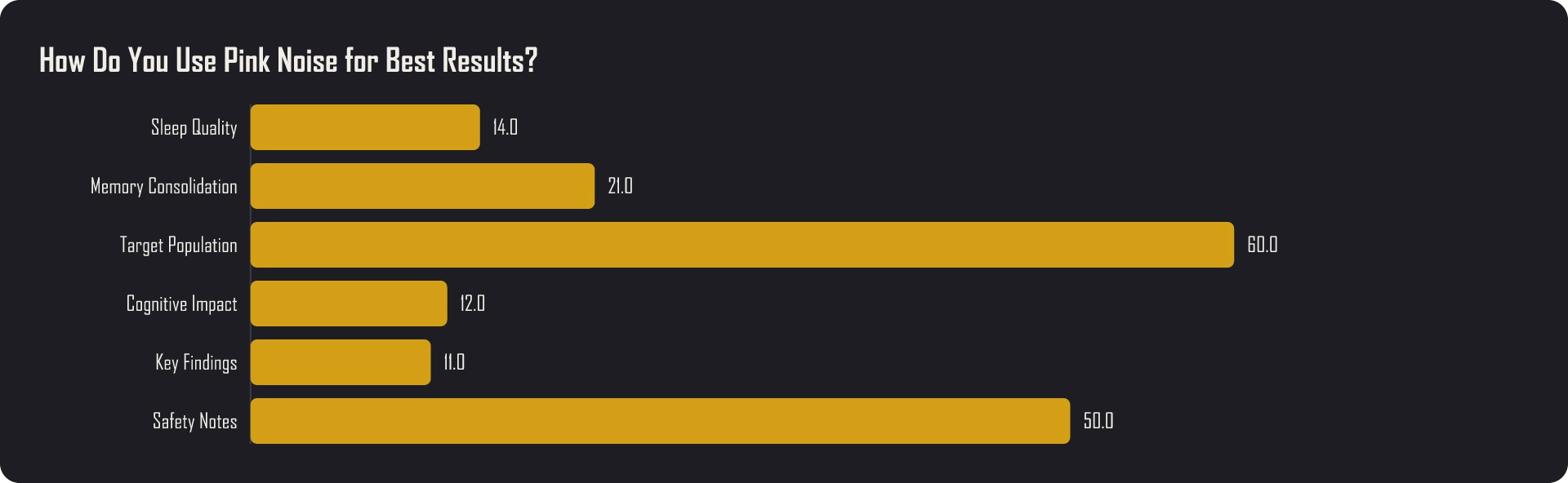
To use pink noise effectively, it is essential to understand its specific applications and limitations. The aim is to optimize potential benefits while following safety guidelines and evidence-based practices.
- Strong evidence for pink noise improving memory comes from a specific method. Papalambros et al. (2017), in sleep-and-memory research, used phase-locked acoustic stimulation, timing pink noise pulses to deep sleep brain oscillations in older adults (60-84 years), improving word recall in a small pilot (n=13, not yet replicated). Consumer continuous pink noise cannot replicate this specialized method.
- Keep pink noise volume below about 50 dB for overnight use. This hearing-safe threshold helps prevent potential hearing damage and sleep disruption. Continuous noise, even at moderate levels, may affect sleep structure. Vickrey et al. (2023) found that continuous overnight pink noise might impair some cognitive functions that rely on sleep.
- Avoid continuous all-night exposure by using timer functions. Play pink noise for specific durations, such as only during the initial hours of sleep, to reduce the potential cognitive impairment linked to prolonged continuous noise exposure.
- Consider specific use cases, but manage expectations for relaxation benefits. Some evidence suggests continuous noise can increase stable sleep duration, but pink noise does not inherently outperform other noise colors for relaxation. Erfanian et al. (2025) found no physiological arousal difference between white, pink, and brown noise. Use the Multi-Color Noise Generator to compare different noise types based on your subjective preference.
- Manage expectations for cognitive benefits from continuous pink noise. Grimaldi et al. (2020) highlighted acoustic stimulation, including pink noise, as a promising neurostimulation technique for sleep enhancement and cognitive improvement in aging. However, Riedy (Sleep Medicine Reviews, 2021), in a systematic review, noted that only a few specifically tested pink noise, with most positive sleep findings coming from phase-locked protocols, not continuous exposure.
- Compare pink noise against other noise colors for masking environmental sounds. The efficacy of pink noise versus white or brown noise for sleep is not definitively established in terms of physiological arousal. Experiment with the Multi-Color Noise Generator to determine which spectral density best suits your needs for sound blockage and comfort.
Free Colored Noise Spectrum Guide
What's Inside:
- Colored noise spectrum comparison chart
- Room-by-room noise masking recommendations
- Tinnitus management protocol overview
Acoustics-informed noise spectrum guidance
What Are the Limitations of Continuous Pink Noise for Sleep?
Continuous pink noise may impair sleep-dependent cognition, a limitation not observed with precisely timed, phase-locked acoustic stimulation protocols. While Riedy et al. suggests continuous noise can increase stable sleep duration, Vickrey et al. (2023) found that continuous overnight pink noise may impair certain cognitive functions that depend on sleep. This contrasts with phase-locked acoustic stimulation, where Papalambros et al. (2017) demonstrated that timed pink noise pulses during deep sleep enhanced slow oscillations and improved word recall in a small pilot (n=13, not yet replicated) in older adults.
Why Does Continuous Pink Noise Differ From Phase-locked Stimulation?
The key distinction is in the delivery method. Most positive findings, particularly those showing memory benefits, used phase-locked stimulation, sound precisely timed to an individual's brain oscillations. Consumer products, including those generated by the Multi-Color Noise Generator, cannot replicate these protocols and instead offer continuous noise.
Erfanian et al. (2025) also found no physiological arousal difference between various noise colors, suggesting that continuous "pink is more relaxing" lacks strong physiological support.
For overnight use, keep pink noise volume below about 50 dB. Use timer functions to avoid continuous all-night exposure, as prolonged use may impair some cognitive functions.
What the Research Actually Agrees on About Pink Noise
Pink noise, specifically phase-locked acoustic stimulation, has been shown to enhance memory consolidation. Strong evidence confirms that this timed stimulation, synchronized with brain oscillations, improves declarative memory. For example, Ngo et al. (2013) demonstrated that closed-loop auditory stimulation could enhance slow oscillations and improve declarative memory [2].
However, continuous exposure shows mixed results for sleep-dependent cognition.
Does Continuous Pink Noise Help You Sleep?
The effect of continuous pink noise on cognitive functions during sleep is debated. Moderate evidence suggests continuous pink noise can increase stable sleep duration. Conversely, other research indicates continuous overnight pink noise may impair some sleep-dependent cognitive functions. This suggests continuous exposure might have nuanced effects on sleep architecture.
How to Use Pink Noise for Sleep Safely
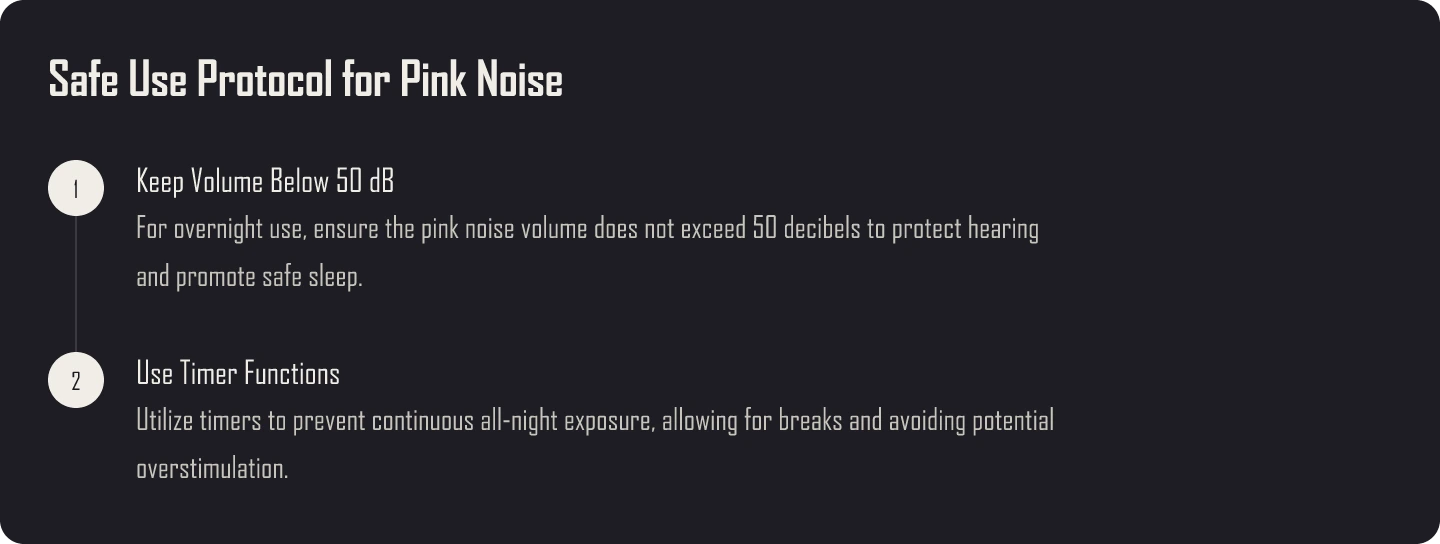
For memory benefits, most research used phase-locked stimulation, which consumer products cannot replicate. To use pink noise for sleep safely, keep volume below about 50 dB for overnight use and use timer functions to avoid continuous all-night exposure. The Multi-Color Noise Generator can help you explore different noise types.
How Does Pink Noise Compare to Other Noise Colors for Sleep?
Phase-locked pink noise can significantly enhance memory consolidation, but continuous pink noise offers mixed benefits compared to other noise colors, with some studies suggesting potential cognitive impairment [5].
| Feature | Pink Noise (Phase-Locked) | Pink Noise (Continuous) | White Noise (Continuous) |
|---|---|---|---|
| Mechanism/Application | Enhances slow oscillations during deep sleep, improving memory consolidation. | May increase stable sleep duration; some cognitive impairment risk. | Masks background sounds, potentially aiding sleep onset. |
| Evidence Quality | Preliminary (Ngo et al. 2013; Papalambros et al. 2019) | Moderate for stable sleep duration; conflicting for cognitive impact. | Moderate for sleep onset/masking. |
| Key Findings | Ngo et al. (2013) found enhanced memory consolidation (small study). Papalambros et al. (2019) extended this to MCI patients, showing enhanced slow oscillations. | May increase stable sleep duration. Vickrey et al. (2023) suggested potential impairment of sleep-dependent cognition. | Unstructured white noise may worsen tinnitus over time, as some clinicians caution. Erfanian et al. (2025) found no arousal difference between noise colors, suggesting "pink is more relaxing" lacks physiological support. |
| Safety Notes | Not applicable for consumer products. | Keep volume below about 50 dB; use timer to avoid continuous all-night exposure. | Keep volume below about 50 dB; use timer. |
Phase-locked pink noise, as demonstrated by Ngo et al. (2013) in Neuron, significantly enhanced memory consolidation by precisely timing sound pulses to slow-wave sleep oscillations. Papalambros et al. (2019) extended these findings to mild cognitive impairment patients, showing enhanced slow oscillations.
However, the efficacy of continuous pink noise is conflicting. While it may increase stable sleep duration, Vickrey et al. (2023) suggested continuous overnight exposure might impair some sleep-dependent cognitive functions. Erfanian et al. (2025) found no physiological arousal difference between various noise colors, including pink and white noise. For safe use, keep any continuous noise below about 50 dB and use timer functions, as demonstrated with the Multi-Color Noise Generator.