This article was developed using structured research synthesis methods. We reviewed peer-reviewed studies indexed in PubMed and related academic journals, prioritized systematic reviews and meta-analyses where available, and provide citations for every major research claim. This content is informational and not a substitute for professional medical advice.
Try the Colored Noise Generator (White, Brown, Pink, Green) Free, browser-based, no account required.
Quick Answer
Colored noise refers to broadband sounds shaped by different frequency-energy profiles, white, pink, brown, green, and blue, each masking sound differently for sleep and focus.
Key Research: colored noise
- Systematic review of noise as a sleep aid found continuous broadband noise (white/pink) may improve subjective sleep quality, but rated the overall quality of evidence as very low, with mixed and inconsistent objective (PSG) findings. Masking environmental noise was the primary mechanism, Riedy et al. 2021
- Most current meta-analysis of white noise RCTs. Age-stratified subgroup analysis found white noise improved sleep quality across age groups, with effects on total sleep time, sleep efficiency, and awakenings. Critically ill and non-critically ill patients both benefited, Ding et al. 2025
- Continuous broadband noise reduced sleep onset latency by 38% in a controlled transient-insomnia model.
PSG-verified finding. No significant change in total sleep time or REM proportion, noise helps you fall asleep, not sleep longer, Messineo et al. 2017
What Is Colored Noise?
White noise has been studied as a way to reduce sleep disruptions and shorten the time it takes to fall asleep. One study by Messineo et al. (2017) found a 38% reduction in sleep onset latency in a controlled transient-insomnia model. Colored noise, a broader category that includes white, pink, brown, and other spectral profiles, is now being explored for its effects on sleep, focus, and mood. Recent meta-analyses, such as Ding et al. (2025), report that white noise can improve sleep quality across age groups, while Mehta et al. (2012) found that moderate ambient noise (around 70 dB) enhances creative thinking by promoting abstract processing [12].
Colored noise refers to sounds characterized by a specific spectral density, the distribution of sound energy across frequencies. Unlike white noise, which has equal energy at all audible frequencies, other "colors" of noise emphasize or de-emphasize certain frequency ranges. This spectral shaping creates distinct auditory experiences, from the deep rumble of brown noise to the bright hiss of blue noise, and is explored using tools like the Colored Noise Generator.
When using any colored noise machine, safety is paramount: keep the volume below about 50 dB for overnight use and place it at least 200 cm (7 feet) from the listener to minimize risk of hearing damage. In this guide, you'll learn how different colored noises work, what the research shows about their effects, and how to use them safely and effectively.
"Meta-analysis of white noise RCTs: improved sleep quality across age groups, with effects on total sleep time, sleep efficiency, and awakenings."
Ding et al. (2025)
Find your optimal focus frequency in under 5 minutes
Blend white, pink, and brown noise in real time. Adjust spectrum until it feels right.
Tune My Noise →What Should You Know About Colored Noise?
Colored noise has been investigated for its potential to influence cognitive states and sleep, but the evidence is mixed and varies by noise type and outcome. For creativity, Mehta et al. (2012) [12] found that moderate ambient noise (around 70 dB) enhanced creative thinking compared to both lower (about 50 dB) and higher (85 dB) noise levels [12]. For sleep, pink noise may support sleep consolidation, but the benefits are not uniform across all colored noise types.
Does Colored Noise Actually Work or Is It Just Placebo?
The effectiveness of colored noise depends on its frequency profile and the intended use. Messineo et al. (2017) demonstrated that continuous broadband noise significantly reduced sleep onset latency in a controlled study, indicating a measurable physiological effect. Zhou et al. (2012) reported that pink noise significantly increased stable sleep duration and reduced brain complexity during NREM sleep, suggesting a role in promoting deeper sleep.
However, a 2021 systematic review (Riedy et al.) concluded that the overall quality of evidence is very low, with some studies reporting improved subjective sleep quality but mixed and inconsistent objective (PSG) findings. This highlights that the evidence base is less robust than some marketing claims suggest. Mechanisms such as brainwave synchronization are still being explored, and individual variability is substantial. Ding et al. (2025) note that no head-to-head trials have directly compared white, brown, and pink noise for adult sleep outcomes, making definitive comparisons challenging.
What Are the Different Colored Noises?
Beyond white and pink noise, other colors are discussed for specific effects, though controlled data is limited. Blue noise, which emphasizes higher frequencies, is sometimes claimed to aid alertness, though evidence is limited. In contrast, lower-frequency noises like brown and green noise are often associated with relaxation and calm. Green noise, centered around 500 Hz, is sometimes described as calming, though controlled evidence is limited.
Safety remains essential: prolonged exposure to sounds above 85 dB can cause permanent hearing damage. Use all sound machines at the lowest effective volume, ideally below about 50 dB for overnight use, and place them at least 200 cm (7 feet) from the listener. For individuals with tinnitus, continuous unstructured white noise may worsen symptoms. Sereda et al. (2018) found that white noise generators did not outperform counseling alone for tinnitus. Consultation with an audiologist is recommended for those with tinnitus [5].
How to Use the Colored Noise Generator
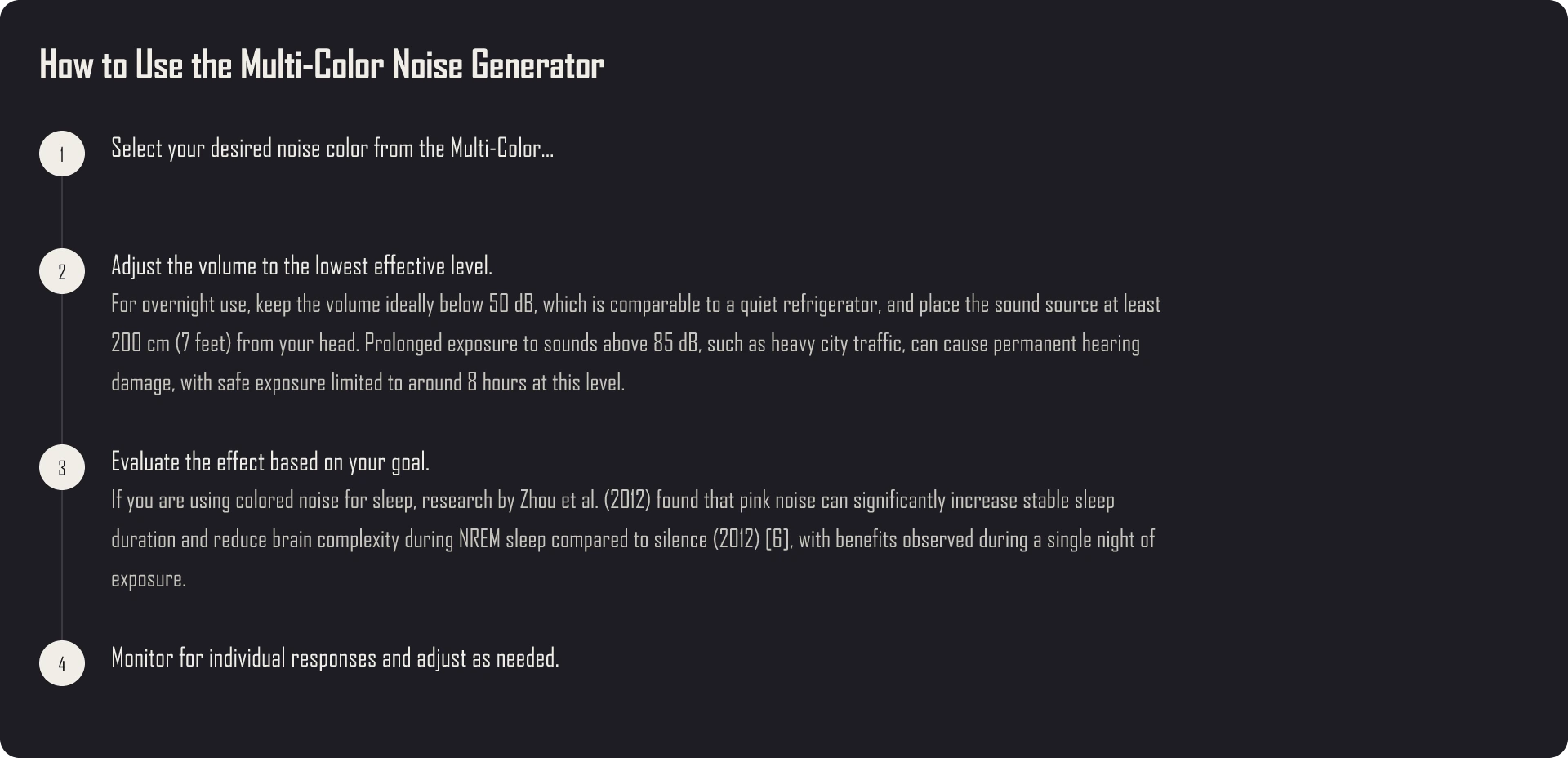
The Colored Noise Generator lets you explore white, brown, pink, and green noise for relaxation, focus, or sleep. Blue and violet are in development. Here’s how to select and apply different colored noise types safely and effectively:
- Select your desired noise color. Each color, such as pink or brown, has a distinct frequency spectrum. Pink noise emphasizes lower frequencies, while brown noise focuses even more on the lowest frequencies, creating a deep rumble. White noise distributes energy evenly across all audible frequencies, often perceived as a static hiss.
- Adjust the volume to the lowest effective level. For overnight use, keep the volume below about 50 dB, comparable to a quiet refrigerator, and place the sound source at least 200 cm (7 feet) from your head. Exposure to sounds above 85 dB, such as heavy city traffic, can cause permanent hearing damage, with safe exposure limited to about 8 hours at this level.
- Evaluate the effect based on your goal. For sleep, Zhou et al. (2012) found that pink noise can increase stable sleep duration and reduce brain complexity during NREM sleep compared to silence [6]. For focus, white noise has been studied for its potential to improve cognitive performance in ADHD; research using white noise at 78 dB for children with ADHD showed enhanced task performance [9] [10].
Colored Noise Generator (White, Brown, Pink, Green) with Spectral Display
Noise colors differ by spectral profile: white (flat), pink (-3 dB/oct), brown (-6 dB/oct), green (mid-range). Our Multi-Color Generator lets you switch instantly with real-time spectral comparison. Hear the difference, see the science.
- ✓ Free to try
- ✓ No account required
- ✓ Works on all devices
Free tool access · Product-design guidance, not medical advice
- Monitor individual responses and adjust as needed. While some users report benefits, Riedy et al. (2021) rated the overall quality of evidence as very low and found mixed, inconsistent objective sleep improvement across studies. Individual variability is high, and the placebo effect can be substantial. People with tinnitus should consult an audiologist before using any colored noise machine, as continuous noise may worsen tinnitus, as noted by Sereda et al. (2018).
How Does Colored Noise Work?
Colored noise provides a consistent sound backdrop that can mask distractions, influence brain activity, or support focus. While many users report improved sleep, objective improvements are less consistent. Riedy et al. (2021) concluded that continuous broadband noise may improve subjective sleep quality, but rated the overall quality of evidence as very low, with mixed and inconsistent objective sleep findings.
The main mechanisms are sound masking and neurological entrainment. For sleep, steady sound can mask sudden environmental noises, like traffic or neighbors, that might otherwise disrupt rest. For focus, certain noise types may optimize brain arousal through a process called stochastic resonance.
The effectiveness of different noise "colors", such as pink or brown, varies depending on the task and individual brain function.
What Are the Different Colored Noises and Their Effects?

"Colored noise" describes sounds with different power distributions across the frequency spectrum, much like light colors vary in their electromagnetic spectrum.
- White noise: Equal power across all audible frequencies; sounds like static hiss.
- Pink noise: More power in lower frequencies, decreasing by 3 dB per octave; sounds "flatter" or "softer" than white noise.
- Brown noise (Brownian or Red noise): Even more power in lower frequencies, decreasing by 6 dB per octave; sounds deeper, like a waterfall or rumble.
These profiles may have distinct effects, though controlled evidence is limited. Brown noise, with its low-frequency emphasis, is anecdotally reported to support sustained attention and a sense of calm. Red noise (very similar to brown) is anecdotally reported to feel deeply relaxing. This points to a possible role for low-frequency noise in contemplative practices, though this remains unverified.
Does Colored Noise Actually Work for Sleep or Focus?
Subjective benefits from colored noise are commonly reported, but objective evidence, especially for sleep, is mixed. Riedy et al. (2021) rated the overall quality of evidence as very low, with some studies reporting improved subjective sleep quality but mixed and inconsistent objective (polysomnography) findings. This means people often feel they sleep better, but physiological markers do not always confirm it.
The primary benefit appears to be masking environmental noise, rather than directly altering sleep architecture.
For cognitive benefits, evidence is more specific to noise type. White noise has been studied for ADHD, with research indicating that white noise at 78 dB improved cognitive performance (recall and recognition) in children with ADHD, but impaired performance in typically developing children. This supports the stochastic resonance model, where noise can optimize arousal for under-attentive brains. Comparable benefits have not been established for brown or pink noise in this context.
Always use sound machines responsibly. Prolonged exposure to sounds above 85 dB can cause permanent hearing damage. Use sound machines at the lowest effective volume, ideally below about 50 dB for overnight use, and place them at least 200 cm (7 feet) from the listener. For those with tinnitus, white noise may worsen symptoms; consult an audiologist before use.
How Does Colored Noise Compare to Similar Options for Sleep and Focus?

Colored noise offers varied acoustic profiles that may assist with sleep and focus. Evidence suggests possible benefits for subjective sleep quality, but the overall quality of evidence is very low and objective improvements are mixed and inconsistent.
| Noise Color | Primary Characteristic | Potential Use Cases | Evidence & Efficacy |
|---|---|---|---|
| White Noise | Uniform power across all audible frequencies. | Masking environmental sounds, sleep aid, focus aid for ADHD. | Ding Y et al. (Sleep Medicine) found white noise improved sleep quality across age groups and in critically ill/non-critically ill patients [2]. Messineo L et al. showed it reduced sleep onset latency by 38% in transient insomnia [3]. |
| Pink Noise | Power decreases by 3 dB per octave; deeper, softer than white noise. | Enhancing deep sleep, improving memory, masking lower-frequency sounds. | Papalambros et al. (2017) demonstrated phase-locked pink noise enhanced slow oscillations and improved memory in older adults. No head-to-head RCTs against other colors for sleep. |
| Brown Noise | Power decreases by 6 dB per octave; deepest, rumbling sound. | Relaxation, masking low-frequency disturbances, calming. | Limited direct clinical trial data specifically on brown noise for sleep or focus compared to white or pink noise. Stochastic resonance for ADHD has not been tested with brown noise. |
| Violet Noise | Power increases at higher frequencies (6 dB per octave); harsh, hissing sound. | Exploring potential in tinnitus management. | Some users found it irritating or an exacerbating factor for tinnitus, despite temporary masking reports. No significant efficacy for sleep or focus. |
Effectiveness often depends on individual auditory perception and specific goals. For sleep, Ding Y et al. found that continuous broadband noise (white and pink) improved subjective sleep quality across diverse populations, including critically ill patients [2]. Messineo L et al. also found that broadband sound reduced sleep onset latency by 38% in healthy subjects with transient insomnia [3]. This suggests that while there are measurable effects, individual responses vary.
For enhancing deep sleep and memory, Papalambros et al. (2017) found that pink noise, when phase-locked to deep sleep brainwaves, could enhance slow oscillations and improve word recall in older adults. For ADHD focus sessions, most evidence supports white noise; studies on stochastic resonance for ADHD have not yet tested other colored noises. Prolonged exposure to sounds above 85 dB can cause permanent hearing damage.
Free Colored Noise Spectrum Guide
What's Inside:
- Colored noise spectrum comparison chart
- Room-by-room noise masking recommendations
- Tinnitus management protocol overview
Acoustics-informed noise spectrum guidance
All sound machines, including the Colored Noise Generator, should be used at the lowest effective volume, ideally below about 50 dB for overnight use, and placed at least 200 cm (7 feet) from the listener. White noise may also worsen tinnitus in some individuals by increasing auditory gain, so consultation with an audiologist is advised.
How Do You Start Exploring Colored Noise?
Getting started with colored noise involves understanding its different types and how they might support specific goals, from improving sleep to enhancing focus. The Colored Noise Generator can help you experiment with these distinct sound profiles.
Here are the steps to begin your journey with colored noise:
- Understand the main types: Different colored noises have unique frequency characteristics. White noise contains all audible frequencies equally, pink noise emphasizes lower frequencies, and brown noise (Brownian noise) has an even greater emphasis on low frequencies, creating a rumble-like sound. Knowing these distinctions helps you select the right sound.
- Identify your goal: Are you seeking better sleep or enhanced concentration? For sleep, continuous broadband noise, including pink and white noise, has been shown to reduce sleep onset latency by 38% in a transient insomnia model (Messineo et al. [3]). Warjri's team also found that white noise delivered via a smartphone app improved sleep quality in ICU patients [4]. For focus, white noise may improve cognitive performance in those with attention deficits, as found by Helps et al. [11].
- Choose your noise color: For sleep, many find pink noise more soothing due to its deeper tone. Some listeners report that continuous pink noise feels calming, though controlled evidence for effects on heart rate variability (HRV) is limited. However, Riedy and colleagues note that the overall quality of evidence is very low, with subjective sleep quality improvements reported in some studies but mixed objective results. For focus, white noise is the most studied for ADHD. Use the Colored Noise Generator to compare sounds.
- Set the volume safely: Prolonged exposure to sounds above 85 dB can cause permanent hearing damage. For overnight use, set your sound machine at the lowest effective volume, ideally below about 50 dB, and place it at least 200 cm (7 feet) from you. People with tinnitus should consult an audiologist before using colored noise, as unstructured noise may worsen symptoms for some individuals.
- Experiment with duration and consistency: Try using colored noise for at least 20-30 minutes before bed or during focus sessions. Observe how different types of colored noise affect you over several days. Individual responses vary; what works for one person might not for another.