
This article was developed using structured research synthesis methods. We reviewed peer-reviewed studies indexed in PubMed and related academic journals, prioritized systematic reviews and meta-analyses where available, and provide citations for every major research claim. Mark Friederich is listed for editorial accountability and evidence governance, not as a sleep-medicine clinician. Next editorial review scheduled for May 2027. This content is informational and not a substitute for professional medical advice.
Try the Sleep Sound Mixer Free, browser-based, no account required.
Quick Answer
pink noise vs white noise for sleep is a bedtime audio approach that uses steady, low-volume sound to mask disruptions and make the transition into sleep feel easier.
Key finding: The strongest sleep-audio evidence comes from music studies: one 5-RCT meta-analysis reported improved sleep quality with music-assisted relaxation (SMD = -0.74; p<0.001) [31].
Bottom line: Keep bedtime audio quiet, steady, and easy to ignore; use it alongside sleep hygiene, not as a replacement for care for chronic insomnia.
Key Research: music and sound for sleep (adjacent evidence)
- Cochrane review evidence suggests listening to music may improve sleep quality in adults with insomnia, with certainty limits, Jespersen et al. 2022
- Survey evidence shows listeners use music for sleep for habit, relaxation, mood regulation, and masking unwanted sound
- Music has been associated with improved sleep quality, Harmat et al. 2008
Pink Noise vs White Noise: Which Sound Supports Better Sleep?

Continuous low-frequency sound, known as pink noise, has been associated with improved memory consolidation in a small study of older adults (Papalambros et al. [10]). In contrast, white noise remains one of the most widely used sound interventions for masking disruptive environments and supporting sleep, with its effects documented in a systematic review by Riedy et al. For many, the decision between pink and white noise is shaped less by their definitions, but by how each sound interacts with the brain’s sleep architecture and individual comfort.
Research from both Papalambros et al. [10] and Riedy et al. demonstrates that pink and white noise offer distinct auditory profiles, each with potential benefits depending on personal needs and sleep settings. In this guide, you'll discover how these two sound types differ, what the strongest scientific evidence reveals about their effects on sleep, and how to test which works best for you.
What Should You Know About Pink Noise vs. White Noise for Sleep?
A systematic review of 38 studies by Riedy et al. found that broadband noise, including both white and pink noise, may reduce sleep onset latency. While both types aim to mask disruptive sounds, their spectral profiles differ, which may lead to varied effects on sleep architecture and specific sleep challenges.
White noise is frequently used to create a consistent background, masking sudden environmental disturbances. However, the same review noted that brown noise has not been directly studied for sleep benefits. Erfanian et al. conducted the first direct comparison of white, pink, and brown noise, finding no significant difference in pupil-linked arousal, a measure of autonomic nervous system activation, between the three. This challenges the assumption that brown noise is inherently more calming than other noise colors [3].
Does Pink Noise Work Better Than White Noise for Specific Sleep Problems?
Pink noise, with its "1/f" frequency profile emphasizing lower frequencies, is theorized to align more closely with natural brainwave patterns during sleep. Zhou et al. [9] reported that pink noise significantly increased stable sleep duration and reduced brain complexity during NREM sleep compared to silence, suggesting a potential mechanism for enhancing sleep consolidation.
For individuals with tinnitus or hyperacusis, the softer quality of pink noise may be more tolerable than the higher-frequency emphasis of white noise. For general sleep improvement, Warjri et al. [5] observed that white noise delivered via a smartphone app was associated with improved sleep quality in critically ill patients, even in high-noise environments [7].
Free: Sleep Audio Quality Index Sample Scores
What's Inside:
- Sample Sleep Audio Quality Index scores for all-night, fall-asleep, masking, and nap presets
- CSV fields for BPM stability, dynamic range stability, harmonic simplicity, and transient risk
- Checklist for interpreting a 0-100 sleep-audio fit score before bedtime
Product-design guidance for sleep audio selection, not medical advice
How to Test Which Noise Type Works Best for You
Finding your ideal noise type often requires a personalized approach. Begin by using the Sleep Sound Mixer interactive tool to experiment with both white and pink noise at a comfortable, low volume to protect hearing. Listen to each for several nights, noting how quickly you fall asleep and your perceived sleep quality. DIY pink noise can be created by filtering white noise through an equalizer to emphasize lower frequencies.
Compare your experience to commercial apps or machines. Pay attention to how each affects your ability to mask common sleep disruptions, such as traffic or snoring. Notice whether one feels more soothing to your nervous system. Some individuals find white noise effective for its consistent masking, while others prefer pink noise for its gentler, more natural sound that may aid brain wave synchronization.
How to Use Pink Noise and White Noise for Better Sleep
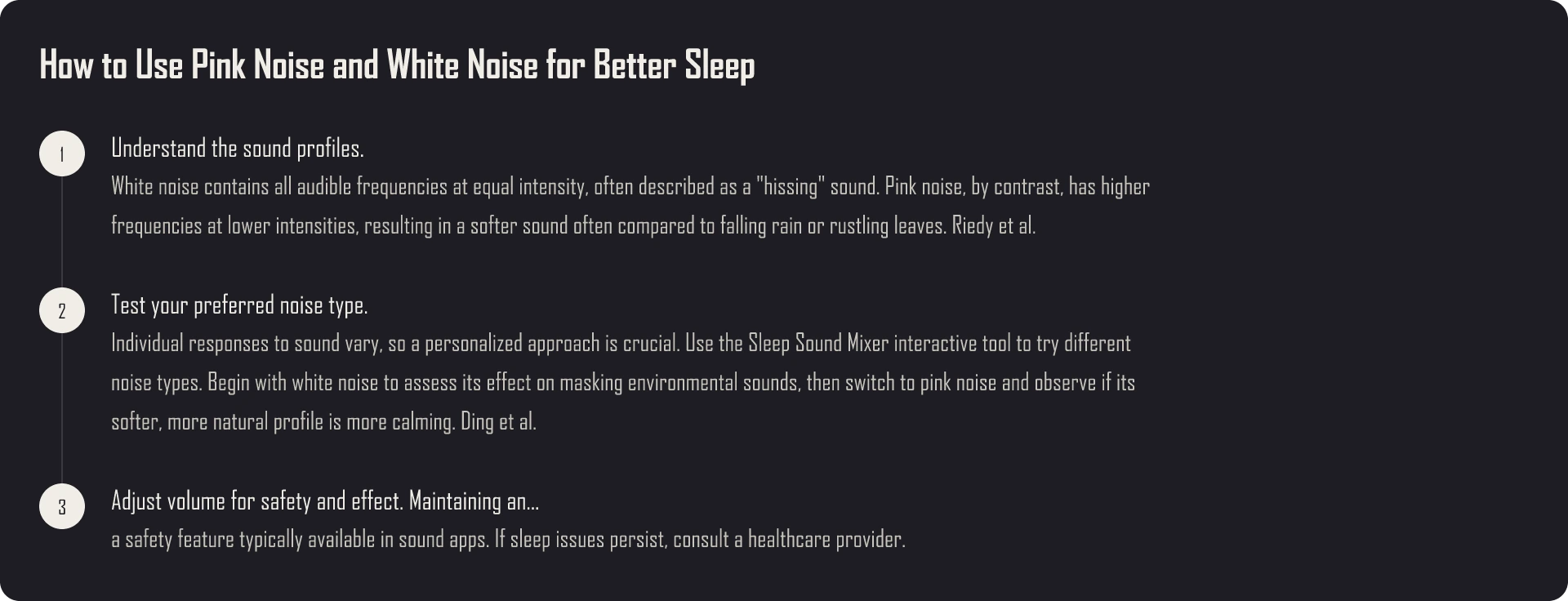
You can incorporate pink or white noise into your sleep routine by understanding their distinct sound profiles, testing your preference, and adjusting the volume for safety and effectiveness. Both types aim to create a consistent sound environment, but research indicates they may interact differently with sleep architecture, particularly regarding brainwave activity. Here are three steps to help you find the ideal noise type for your sleep:
-
Understand the sound profiles. White noise contains all audible frequencies at equal intensity, often described as a "hissing" sound. Pink noise, by contrast, has higher frequencies at lower intensities, resulting in a softer sound often compared to falling rain or rustling leaves. Riedy (Sleep Medicine Reviews) [4] reviewed 38 studies on noise as a sleep aid, noting that evidence supports white and pink noise, but not brown noise specifically. Papalambros et al. [10] found that phase-locked pink noise pulses during deep sleep enhanced slow oscillations and improved morning word recall in older adults, suggesting a unique interaction with deep sleep brainwaves.
-
Test your preferred noise type. Individual responses to sound vary, so a personalized approach is crucial. Use the Sleep Sound Mixer interactive tool to try different noise types. Begin with white noise to assess its effect on masking environmental sounds, then switch to pink noise and observe if its softer, more natural profile is more calming. Ding (Sleep Medicine) published a meta-analysis focusing exclusively on white noise, highlighting its prevalence in research. The absence of brown noise in randomized controlled trials means its benefits are extrapolated, not directly demonstrated [2].
-
Adjust volume for safety and effect. Maintaining an appropriate volume is essential. Warjri et al. [5] found that white noise delivered via a smartphone app was associated with improved sleep quality in critically ill patients. Lower volumes are generally recommended. Always keep the volume comfortable and low. For scale, every one of the 14 infant sleep machines Hugh et al. measured exceeded the 50 dB recommended for hospital nurseries at 30 cm, and three exceeded 85 dB [16]. If sleep issues persist, consult a healthcare provider.
Recommended Tool: Calm, $69.99/yr Award-winning sleep and meditation app Try Calm Free for 7 Days →
Sleep Audio Quality Index: Score the Track Before Bed
The Sleep Audio Quality Index is Restful Night Studios' first-party 0-100 sleep-audio fit score. It weighs BPM or heartbeat stability (30%), dynamic range stability (25%), harmonic simplicity (25%), and awakening-risk transients (20%) so sleep tracks can be compared by the audio features most likely to affect overnight continuity.
Use it as product-design guidance, not as a clinical claim. A high score means the track is more likely to stay steady, quiet, harmonically simple, and free of sudden peaks. It does not prove that the track treats insomnia, sleep apnea, anxiety, depression, or any medical condition.
| Sleep-audio example | Sample SAQI score | Best fit |
|---|---|---|
| Ambient drone with soft fade | 88 | Falling asleep in a quiet room |
| Rain layer with pink-noise bed | 85 | Masking household noise |
| Gentle classical adagio | 74 | Relaxation before lights out |
| Upbeat lo-fi track with lyrics | 41 | Avoid for bedtime focus |
In our studio QA workflow, we use the same score to flag sleep tracks that need manual listening before they appear in the Sleep Sound Mixer.
For all-night audio, the current methodology favors 45-65 BPM when a pulse is present, restrained dynamic range, simple harmony, and low transient-event frequency. The public methodology and sample score CSV make the scoring contract reusable across this sleep audio cluster.
Choose Sleep Audio by Problem, Not by Genre
Use this table as product-design guidance, not medical advice. The Sleep Audio Quality Index helps compare the acoustic fit of a track; it does not prove that any track treats insomnia, sleep apnea, anxiety, depression, or another medical condition.
| Sleep need | Best first audio choice | Avoid if | Evidence strength | Recommended preset |
|---|---|---|---|---|
| Racing thoughts before bed | Slow, lyric-free music or guided relaxation | Spoken tracks make you more alert | Moderate for subjective sleep quality | Ambient 60-70 BPM, 30-60 minute fade |
| Traffic, neighbors, or household noise | Rain, pink noise, or steady broadband masking | Masking level needs to get loud to cover the noise | Moderate for masking logic; mixed for sleep outcomes | Rain + pink-noise bed, low stable volume |
| Light sleeper worried about sudden peaks | Ambient drone or soft pad with low transient risk | Tracks include ads, bells, crescendos, or abrupt loops | Product-design guidance from SAQI features | All-night low-transient preset |
| Nap or short wind-down | Short guided relaxation or soft pulse | You need silence to wake quickly | Low-to-moderate; highly individual | Nap mode, 15-30 minute fade |
| Clinical insomnia symptoms | Audio only as a comfort layer alongside CBT-I or clinician care | You are using audio instead of evidence-based treatment | Stronger evidence for CBT-I than audio | Gentle support preset, not treatment |