This article was developed using structured research synthesis methods. We reviewed peer-reviewed studies indexed in PubMed and related academic journals, prioritized systematic reviews and meta-analyses where available, and provide citations for every major research claim. This content is informational and not a substitute for professional medical advice.
Quick Answer
meditation music benefits is audio chosen to support meditation by lowering distraction, setting a steady session pace, or helping beginners settle into practice.
Key finding: A 12-week trial found music listening and Kirtan Kriya meditation produced comparable improvements in stress, mood, sleep, and cognitive measures.
Bottom line: Use quiet, low-lyric audio when it helps you start or stay present; switch toward silence when the soundtrack becomes the main focus.
Key Research: meditation music benefits
- JAMA meta-analysis: meditation produced small to moderate reductions in anxiety (d=0.38), depression (d=0.30), and pain (d=0.33). No evidence of improvement beyond active controls for stress, distress, or quality of life. Sets realistic expectations for meditation benefits, Goyal et al. 2014
- 12-week pilot RCT: both meditation and music listening showed comparable benefits for memory, cognitive function, stress, mood, and sleep. Music listening was as effective as Kirtan Kriya meditation. Benefits sustained at 6-month follow-up, Innes et al. 2017
- Tibetan singing bowl meditation significantly reduced tension, anger, fatigue, and depressed mood. The most-cited study on singing bowl meditation. However, observational design (no control group) means effects could be due to group setting, expectation, or relaxation alone, Goldsby et al. 2017
What Are the Benefits of Meditation Music?

In 2014, the JAMA Internal Medicine review led by Goyal and colleagues delivered a sobering but important finding: meditation produced only small to moderate improvements in anxiety, depression, and pain. These benefits, while real, did not surpass those of other active treatments. Yet, for many, the question remains: can music enhance the meditation experience or even offer similar support? A 12-week randomized controlled trial (Innes et al., 2017) found that both meditation and music listening led to comparable improvements in memory, cognitive function, stress, mood, and sleep among adults with subjective cognitive decline. Music listening was as effective as Kirtan Kriya meditation in this context.
What might explain these effects? Chanda and Levitin's review of music's impact on neurochemical pathways, including dopamine and serotonin, suggests plausible mechanisms, though direct evidence remains limited. It's clear from meta-analytic reviews that meditation music should not be viewed as a standalone treatment for clinical anxiety or depression. Rather, its benefits are best understood as supportive and modest, complementing established therapies. In this article, you'll learn what the research actually shows about meditation music, how it compares to silent meditation, and how to select music that genuinely supports your practice.
"12-week study: both meditation and music listening showed comparable benefits for stress, mood, and sleep, sustained at 6 months."
What Are the Evidence-backed Meditation Music Benefits?

Meditation music appears to offer modest support for well-being. The Innes et al. (2017) [4] randomized controlled trial showed that both meditation and music listening groups experienced similar improvements in memory, cognitive function, stress, mood, and sleep, with these effects persisting at a 6-month follow-up. A separate randomized trial in breast cancer survivors likewise found that mantra meditation and music listening produced comparable, sustained neurocognitive benefits [11]. However, neither trial directly compared music-assisted meditation to silent meditation, so whether music enhances outcomes over silence remains an open question.
Does Meditation Music Actually Work, or Is Silence Better?
Setting realistic expectations is essential. According to the JAMA meta-analysis (Goyal et al. 2014), meditation itself produces only small to moderate reductions in anxiety and depression, and is not superior to active comparison treatments such as exercise or cognitive behavioral therapy. For meditation music specifically, no controlled trial has directly compared meditation with music to silent meditation. Thus, while music listening can be beneficial, it cannot be definitively stated that it makes meditation more effective than silence.
Meditation music is best considered a complementary tool. If music helps you settle into practice or reduces distractions, it may support your routine. On the other hand, if music becomes a distraction, silent meditation may be preferable. Sorensen et al. (2018) [12] explored the integration of Loving-Kindness Meditation with classical guitar music, suggesting that the type of music and how it is incorporated can influence outcomes.
How to Pick the Right Meditation Music That Doesn't Distract You
Selecting meditation music is largely a matter of personal preference and its fit with your practice. No studies have identified specific musical features (such as tempo or instrumentation) that optimize meditation, so individual experimentation is recommended.
For mood and tension, observational studies on Tibetan singing bowl meditation (Goldsby et al., 2017) report positive associations [5]. However, these studies lack control groups, so effects may be due to group dynamics, expectation, or general relaxation rather than the music itself.
Meditation music should not be viewed as a validated treatment for clinical anxiety, depression, or other mental health conditions. It may complement evidence-based interventions but is not a substitute for professional care. If you experience persistent mental health concerns, consult a healthcare professional.
How Can You Use Meditation Music Effectively?
Free: Meditation Audio Fit Index Sample Scores
What's Inside:
- Sample Meditation Audio Fit Index scores for guided, breath, focus, classroom, sleep wind-down, and sound bath presets
- CSV fields for speech load, lyric load, pulse stability, dynamic softness, and loop continuity
- Checklist for interpreting a 0-100 meditation-audio fit score before publishing a preset
Product-design guidance for meditation audio selection, not medical advice
Listening to meditation music may help reduce stress and support focus. Several studies, including Chanda et al., have shown that music can influence neurochemical systems involved in stress regulation. However, music is not a validated clinical treatment for mental health conditions [10].
To use meditation music effectively:
-
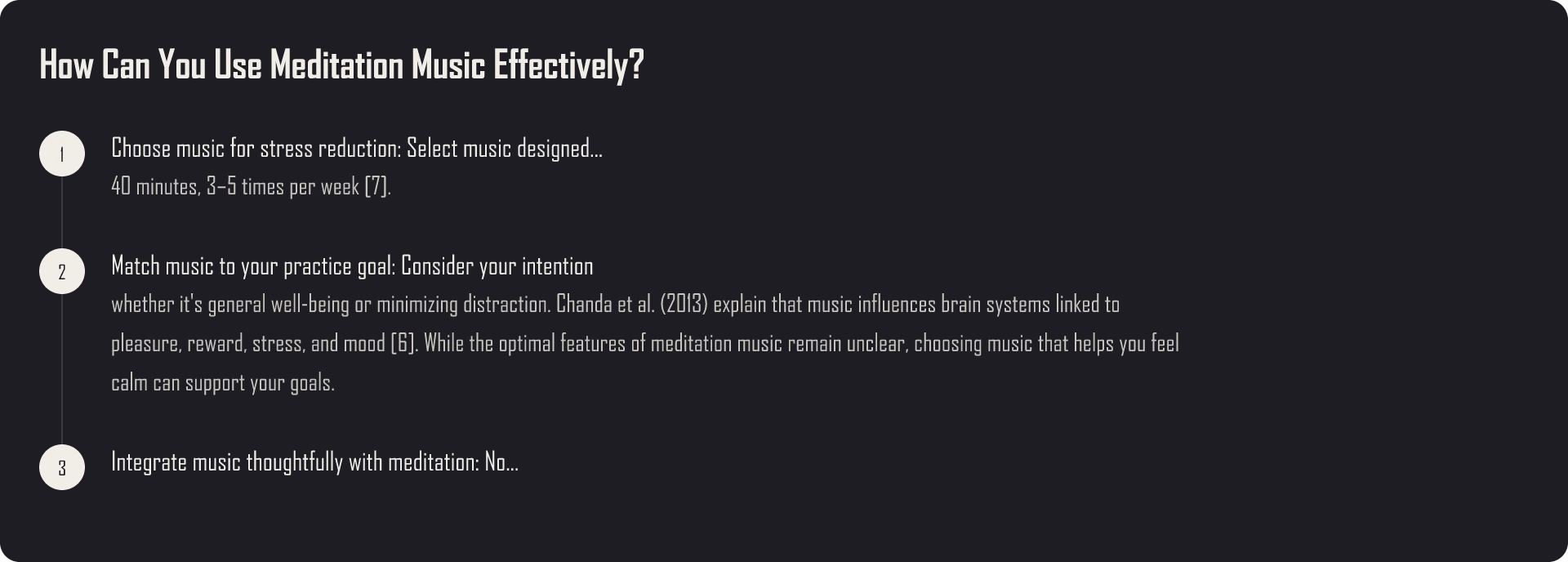
Choose music for stress reduction: Select music designed to promote calm. Systematic reviews, such as de Witte et al., indicate that music interventions can reduce stress in various settings. Chanda et al. (2013) found that music affects neurochemical systems related to stress, such as cortisol. This suggests that music can help manage daily stress, similar to brief mindfulness exercises. For stress reduction, listening for a sustained, comfortable period may help.
-
Match music to your practice goal: Consider your intention, whether it's general well-being or minimizing distraction. Chanda et al. (2013) explain that music influences brain systems linked to pleasure, reward, stress, and mood. While the ideal features of meditation music remain unclear, choosing music that helps you feel calm can support your goals. Try different soundscapes for 10-minute intervals to see what best enhances your focus and relaxation.
-
Integrate music thoughtfully with meditation: No controlled study has shown that adding music to meditation improves outcomes over silent meditation. For example, the widely cited Marconi Union 'Weightless' track originated as a commercial sound-therapy collaboration and has not been validated by peer-reviewed research. Some listeners find it relaxing, but its direct benefit to meditation practice is unproven. If music feels distracting, silence may be preferable. For beginners, music might aid concentration during short sessions, while experienced practitioners may opt for silence or occasional music.
Choose the right option for meditation music benefits
Use this matrix as practical decision support. Evidence strength describes the nearest research base; it does not mean the page, audio tool, or practice treats a medical, educational, or safety condition.
| Situation | Choose first | Avoid if | Evidence strength | Best tool action |
|---|---|---|---|---|
| Beginner meditation | Simple guided breath session | music becomes a distraction | Structured meditation has the strongest direct evidence [4] | Meditation Music Player: beginner session |
| Music-supported practice | Low-lyric instrumental or ambient track | lyrics or crescendos compete with attention | Music may support stress reduction, but evidence is adjacent [3] | Meditation Music Player: low-distraction music |
| Deep attention practice | Silence or bell timer | external audio becomes the main focus | Silent/structured meditation evidence is stronger than audio-only evidence [4] | Meditation Music Player: bell-only timer |
| Quick stress downshift | 5-10 minute guided relaxation | symptoms are severe or persistent | Use as wellness support, not treatment [4] | Meditation Music Player: short reset |
| Sound-focused meditation | Singing bowl or steady tone at low volume | tones feel irritating or physically uncomfortable | Sound-practice evidence is narrower and preference-sensitive [6] | Meditation Music Player: steady tone |
Evidence, entity, and update status for meditation music benefits
Entity boundary: meditation music benefits is treated as a meditation-audio selection category for practice support. Parent concepts: Meditation, Mindfulness, Music.
Source directness: Direct to adjacent. The registry covers meditation, music, stress, and practice support; no narrow modifier is required.
| Source | What it supports on this page | Confidence |
|---|---|---|
| Complementary and Alternative Medicine in Hospice and Palliative Care: A Systematic Review [1] | Complementary and Alternative Medicine in Hospice and Palliative Care: A Systematic Review is included as supporting evidence for meditation music benefits. | High |
| Mental Health Benefits of Listening to Music During COVID-19 Quarantine: Cross-Sectional Study [2] | Mental Health Benefits of Listening to Music During COVID-19 Quarantine: Cross-Sectional Study is included as supporting evidence for meditation music benefits. | High |
| Meditation Programs for Psychological Stress and Well-being [3] | JAMA meta-analysis: meditation produced small to moderate reductions in anxiety (d=0.38), depression (d=0.30), and pain (d=0.33). | High |
| Meditation and Music Improve Memory and Cognitive Function in Adults with Subjective Cogniti... [4] | 12-week pilot RCT: both meditation and music listening showed comparable benefits for memory, cognitive function, stress, mood, and sleep. Music listening was as effective as Kirtan Kriya meditation. | High |
| Effects of Singing Bowl Sound Meditation on Mood, Tension, and Well-being: An Observational... [5] | Tibetan singing bowl meditation significantly reduced tension, anger, fatigue, and depressed mood. The most-cited study on singing bowl meditation. | High |
Background coverage: 10 additional registry sources used for adjacent mechanisms, source transparency, and update checks.
Evidence search date: May 2026. Included source range: 2012-2026. Next scheduled review: May 2027, or sooner if new randomized trials, systematic reviews, or safety guidance changes the evidence base.
Meditation Audio Fit Index: Score the Track Before the Session
The Meditation Audio Fit Index is Restful Night Studios' first-party 0-100 meditation-audio fit score. It weighs low distraction load (30%), attentional stability (25%), dynamic softness (20%), practice match (15%), and session continuity (10%) so meditation tracks can be compared by the audio features most likely to affect a session.
Use it as product-design guidance, not as a clinical claim. A high score means the track is more likely to keep speech, lyrics, loudness, transients, and loop seams aligned with the selected use case. It does not prove that the track treats anxiety, insomnia, ADHD, depression, or any medical condition.
| Meditation-audio example | Sample MAFI score | Best fit |
|---|---|---|
| Guided body-scan bed with soft fades | 88 | Guided meditation or sleep wind-down |
| Breath bell with stable pulse | 85 | Breath practice |
| Classroom pad with low speech load | 82 | Classroom calm |
| Lyric-heavy relaxation track | 38 | Avoid for focused meditation |
In our studio QA workflow, we use the same score to flag meditation tracks that need manual listening before they appear in the meditation audio players.
For guided sessions, the current methodology allows meaningful speech coverage. For breath practice, classroom calm, sleep wind-down, focus, and sound baths, it favors lower foreground speech, stable dynamics, gentle transients, and clean endings. The public methodology and sample score CSV make the scoring contract reusable across this meditation audio cluster.